Showing posts with label Vocal Jazz. Show all posts

Tuesday, September 22, 2026

Billie Holiday • The Sensitive Billie Holiday 1940-49


The 26 tunes with Billle Holiday on this 77 min CD span the years 1940-1949. There are eleven different sessions on the CD both live and studio ranging from a duo number with piano to octets and full orchestra. lncluded on the CD are Billie Holiday’s last official recordings with tenor saxophonist Lester Young and pianist Teddy Wilson. The repertoire consists mostly of Billie Holiday ballad and blues standards. Accompanying Billie Holiday on this CD are many other masters af jazz, including Roy Eldridge, Red Norvo, Don Byas, Benny Carter, Barney Bigard, Coleman Hawkins, Jimmy Hamilton, Hot Lips Page and Art Tatum. 9 Fantastic live sessions include the Esquire AllAmerican Poll Winners Concert from 1944, an Apollo Theater concert from 1945, and eight tunes from the Just Jazz Concert in Los Angeles with the Red Norvo Septet in 1949. Billie Holiday sings wonderfully throughout: check out her blues renditions of “St. Louis Blues” and “Loveless Love”.
https://storyvillerecords.com/product/billie-holiday-1940-49/

///////

Los 26 temas con Billle Holiday en este CD de 77 minutos abarcan los años 1940-1949. Hay once sesiones diferentes en el CD, tanto en directo como en estudio, que van desde un número a dúo con piano hasta octetos y orquesta completa. En el CD se incluyen las últimas grabaciones oficiales de Billie Holiday con el saxofonista tenor Lester Young y el pianista Teddy Wilson. El repertorio se compone principalmente de baladas y estándares de blues de Billie Holiday. Acompañan a Billie Holiday en este CD muchos otros maestros del jazz, como Roy Eldridge, Red Norvo, Don Byas, Benny Carter, Barney Bigard, Coleman Hawkins, Jimmy Hamilton, Hot Lips Page y Art Tatum. 9 Fantásticas sesiones en directo que incluyen el Esquire AllAmerican Poll Winners Concert de 1944, un concierto del Apollo Theater de 1945 y ocho temas del Just Jazz Concert de Los Ángeles con el Red Norvo Septet en 1949. Billie Holiday canta maravillosamente en todo el disco: fíjate en sus interpretaciones de blues de "St. Louis Blues" y "Loveless Love".
https://storyvillerecords.com/product/billie-holiday-1940-49/


storyvillerecords.com ...


Thursday, September 17, 2026

The Jonah Jones Quartet • Swingin' On Broadway


Monday, September 14, 2026

Sarah Vaughan • Swingin' Easy


Review from AllMusic (by Ken Dryden):
Swingin' Easy is one of Sarah Vaughan's lesser known albums for Emarcy, combining two separate trio sessions from 1954 and 1957. The earlier date includes pianist John Malachi, bassist Joe Benjamin and drummer Roy Haynes. Vaughan's lush ballad technique is in full force in "Lover Man," "Polka Dots and Moonbeams," and "Body and Soul," while she scats in a midtempo setting of "If I Knew Then (What I Knew Now)" and her own "Shulie a Bop." The second trio includes pianist Jimmy Jones, bassist Richard Davis, and Haynes. Aside from a brisk, miniature treatment of "Linger Awhile" and a playful setting of "I Cried for You," the session is highlighted by a breezy "All of Me." Vaughan is in terrific form throughout both dates, with the songs mostly running around the three-minute mark.
https://www.allmusic.com/album/swingin-easy-mw0000616747

///////

Reseña de AllMusic (por Ken Dryden):
Swingin' Easy es uno de los álbumes menos conocidos de Sarah Vaughan para EmArcy y combina dos sesiones diferentes de trío, de 1954 y 1957. En la primera participaron el pianista John Malachi, el contrabajista Joe Benjamin y el baterista Roy Haynes. La extraordinaria técnica de Vaughan para las baladas se manifiesta plenamente en "Lover Man", "Polka Dots and Moonbeams" y "Body and Soul", mientras que realiza scat en "If I Knew Then (What I Knew Now)" y en su propia composición "Shulie a Bop". El segundo trío incluye al pianista Jimmy Jones, el contrabajista Richard Davis y Haynes. Además de una versión breve y ágil de "Linger Awhile" y una interpretación juguetona de "I Cried for You", la sesión destaca por una animada versión de "All of Me". Vaughan se encuentra en una forma extraordinaria a lo largo de ambas sesiones, con temas que duran generalmente alrededor de tres minutos.


Friday, August 28, 2026

Lil Hardin & Her Swing Orchestra, 1936-1940


Lillian Hardin Armstrong (née Hardin; February 3, 1898 – August 27, 1971) was an American jazz pianist, composer, arranger, singer, and bandleader. She was the second wife of Louis Armstrong, with whom she collaborated on many recordings in the 1920s.
Her compositions include "Struttin' with Some Barbecue", "Don't Jive Me", "Two Deuces", "Knee Drops", "Doin' the Suzie-Q", "Just for a Thrill" (which was a hit when revived by Ray Charles in 1959), "Clip Joint", and "Bad Boy" (a hit for Ringo Starr in 1978). Armstrong was inducted into the Memphis Music Hall of Fame in 2014.

Background
Lil's grandmother, Priscilla Martin, was a former slave from near Oxford, Mississippi. Martin had a son and three daughters, one of whom was Dempsey, Lil's mother. Priscilla Martin moved her family to Memphis to escape from her husband, a trek the family made by mule-drawn wagon. Dempsey married Will Harden, and Lillian Hardin was born on February 3, 1898. She grew up in a household with her grandmother. Will died when Lil was seven. Dempsey later remarried to John Miller.
During her early years, Hardin was taught hymns, spirituals, and classical music on the piano. She was drawn to popular music and later blues.

Early education and mentors
Hardin first received piano instruction from her third-grade teacher, Violet White. Her mother then enrolled her in Mrs. Hook's School of Music. At Fisk University, a college for African Americans in Nashville, she received more advanced training, and earning a diploma from Fisk, returned to Memphis in 1917. In August 1918, she moved to Chicago with her mother and stepfather. By then she had become a proficient sight-reader, a skill that helped her gain a job as a sheet music demonstrator at Jones Music Store.
The store paid Hardin $3 a week (US$58 in 2022 dollars), but bandleader Lawrence Duhé offered $22.50 (US$438 in 2022 dollars). Knowing that her mother would disapprove of her working in a cabaret, she made it known that her new job was playing for a dancing school. As observed by Thomas Brothers, the discrepancies between her education and that of Duhé's band members were apparent; when she asked what key the New Orleanians were going to play in, they remarked, "We don't know what key. When you hear two knocks start playing." Three weeks later the band moved to a better booking at the De Luxe Café, where the entertainers included Florence Mills and Cora Green. From there, the band moved up to Dreamland. Here the principal entertainers were Alberta Hunter and Ollie Powers. When King Oliver's Creole Jazz Band replaced Duhé's group at Dreamland, Oliver asked Hardin to stay with him. She was with Oliver at Dreamland in 1921 when an offer came for the orchestra to play a six-month engagement at the Pergola Ballroom in San Francisco. At the end of that booking Hardin returned to Chicago while the rest of the Oliver band went to Los Angeles. She later studied at the New York College of Music, where she earned a post-graduate diploma in 1929.

Marriages and divorces
In Chicago, Hardin returned to work at Dreamland as a pianist in an orchestra for Mae Brady, a violinist and vaudeville stalwart. While there, she fell for Jimmie Johnson, a young singer from Washington, D.C., whom she married on August 22, 1922. The marriage was short-lived, ending in divorce. The Oliver band returned from California and opened at the Royal Gardens with Bertha Gonsoulin at the piano but soon found itself back at Dreamland with Hardin at the piano.
King Oliver's band was enjoying enormous success at Dreamland when he sent for Louis Armstrong to join as second cornetist. Armstrong was beginning to make a name for himself in New Orleans and regarded Oliver ("Papa Joe") as his mentor. At first, Hardin was unimpressed, remembering that she "was very disgusted" by Louis, who arrived in Chicago wearing clothes and a hair style that she deemed to be "too country" for Chicago, but she worked to "take the country out of him", and a romance developed (to the surprise of other band members, some of whom had been trying to woo her for some time with no success). They would visit cabarets and after-hour spots after their job at Lincoln Gardens, but their relationship was solidified after Armstrong's mother's intervention in 1923, when she visited Armstrong in Chicago. She and Armstrong needed to be divorced from their previous relationships (Lil Hardin to Jimmie Johnson, Louis Armstrong to Daisy Armstrong) and "claimed desertion" from said relationships to annul the marriages. Hardin and Armstrong were married on February 5, 1924, and honeymooned/toured with the Oliver band in Biglerville, Pennsylvania. The Defender noted that Hardin was dressed in a "Parisian gown of white crepe elaborately beaded in rhinestones and silver beads."
Hardin took Armstrong shopping and taught him how to dress more fashionably. She got rid of his bangs and began working to foster his career. In addition to updating his appearance, Hardin assisted Armstrong in learning classical music with the help of a German teacher in Chicago. She felt he was wasting his talent in a secondary role. Armstrong was happy to be playing next to his idol, but Hardin at first persuaded him to manage his own money and assert himself on the bandstand and during recording sessions; eventually, she convinced him to leave Oliver and go out on his own. Armstrong resigned from Oliver's band and in September 1924 accepted a job with bandleader Fletcher Henderson in New York City. Hardin stayed in Chicago, first with Oliver, then leading a band of her own. When Hardin's band got a job at the Dreamland Café in Chicago she prepared for Armstrong's return to Chicago by having a huge banner that read "The World's Greatest Trumpet Player".
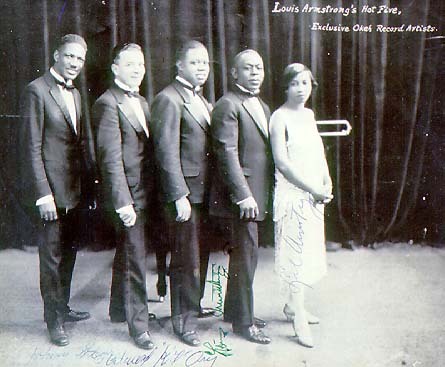
Richard M. Jones convinced Okeh Records to make a series of sessions under his name: the Armstrong "Hot Five" recordings. With Hardin at the piano, Kid Ory on trombone, Johnny Dodds on clarinet, and Johnny St. Cyr on banjo, this group rehearsed at Armstrong and Hardin's residence on Chicago's East 41st Street and held its first session on November 15, 1925.
In the late 1920s, Hardin and Armstrong grew apart due to class differences and money issues. He formed a new Hot Five with Earl Hines on piano. Hardin reformed her own band with Freddie Keppard, whom she considered second only to Armstrong. Hardin and Armstrong separated in 1931 when he had a liaison with Alpha Smith, who threatened to sue Armstrong for breach of promise, so he begged Hardin not to grant him a divorce. They finally divorced in 1938.

Later years
In the 1930s, sometimes billing herself as "Mrs. Louis Armstrong", Hardin led an "All Girl Orchestra", a mixed-sex big band which broadcast nationally over the NBC radio network. In the same decade she recorded for Decca as a swing vocalist and performed as piano accompanist for other singers. She also performed with Red Allen.

Solo work
In the late 1940s and early 1950s, Hardin worked mostly as a soloist, singing and playing piano. In the late 1940s, she decided to leave the music business and become a tailor, so she took a course in tailoring. Her graduation project was to make a tuxedo for Armstrong.
Hardin returned to Chicago and the house on East 41st Street. She made a trip to Europe and had a brief love affair in France, but mostly she worked around Chicago, often with fellow Chicagoans. Collaborators included Red Saunders, Joe Williams, Oscar Brown Jr., and Little Brother Montgomery.
In the 1950s, Hardin recorded a biographical narrative for Bill Grauer at Riverside Records that was issued in LP form. She would again appear on that label in 1961, participating in its project Chicago: The Living Legends as accompanist for Alberta Hunter and leader of her own hastily assembled big band. The Riverside recordings led to her inclusion in a 1961 NBC network special, Chicago and All That Jazz, and a follow-up album released by Verve. In 1962, she began writing her autobiography with Chris Albertson, but she changed her mind when she realized the book would include experiences that might discomfit Louis Armstrong, so the project was delayed until his death. She died before finishing the book.

Death
When Louis Armstrong died in 1971, she traveled to New York for the funeral and rode in the family car. Returning to Chicago, she felt that work on her autobiography could continue, but the following month, performing at a televised memorial concert for Armstrong, she collapsed at the piano and died from a heart attack on the way to the hospital. After her funeral, her letters and the unfinished manuscript of her autobiography disappeared from her house.
She was interred at Lincoln Cemetery in Blue Island, Illinois.
In 2004, the Chicago Park District renamed a community park in her honor.

Legacy
Hardin's song "Bad Boy" was recorded by Ringo Starr in 1978 and became an international pop hit.
Armstrong's composition "Oriental Swing" was sampled by electro swing musician Parov Stelar to create the 2012 song "Booty Swing". The song gained notoriety when it was used in a 2013 Chevrolet commercial.
https://en.wikipedia.org/wiki/Lil_Hardin_Armstrong  


Lil Harding [1898-1971] fue la primera mujer extraordinaria en el jazz en la década de los años 20, dándose a conocer en la banda de King Oliver.

Pianista destacada en una época cuando los instrumentos estaban dominados por hombres, cantante, arreglista, directora de bandas y gran compositora. Entre sus muchas composiciones están los famosos Struttin´ With Some Barbecue, Don´t Jive Me, Just For A Thrill (revivida por Ray Charles en 1959) y Bad Boy (reinterpretada por Ringo Starr en 1978 con mucho éxito).

Lil fue también la segunda esposa de Louis Arrmstrong, con quien dejó muchas grabaciones hechas en los años 20, Lil Harding toca piano en el conjunto de King Oliver en una de sus primeras grabaciones; en ese grupo estaba también el protegido de Oliver, Louis Armstrong.


Bio:
Nació en Memphis, Tennessee (EE UU) y tuvo una formación clásica en piano al asistir desde pequeña a una escuela de música, y que continuó en la Fisk University.
En 1918, Lil se traslada junto a su madre y su padrastro a Chicago y comienza a trabajar en una tienda de música llamada Jones Music Store. Su propietaria, Jennie Jones, también era agente de música y, conociendo las dotes musicales de Lily, la animó para que aceptase tocar en alguna banda de música swing o jazz. Sin embargo, la madre de Lil no veía con buenos ojos esa música a la que calificaba de "pecado".
Lillian, para poder tocar en la banda del clarinetista Lawrence Duhe, engañó a su madre diciéndola que tocaba en una escuela de danza. De allí, la banda fue cogiendo fama en los clubes de Chicago hasta que en 1921 se asentó en uno de los locales nocturnos más importantes de la ciudad: "The Dreamland". Fue allí donde conoció a Joe King Oliver y éste la ofrece el puesto de pianista en su grupo Creole Jazz Band. Hardin toca con ellos durante un tiempo limitado tanto en Chicago como el San Francisco, pero cuando la banda se traslada a Los Ángeles, Lil decide volver a su ciudad.
Lillian Hardin vuelve a trabajar en el local "Dreamland" como pianista, y allí conocería a Jimmie Johnson, un cantante más joven que ella del que se enamoraría. Se casaron en 1922, pero se separaran poco tiempo después. Es entonces cuando la Creole Jazz Band regresa a Chicago y Joe King Oliver la vuelve a ofrecer el puesto de pianista; ella acepta.
En 1922, Oliver invita a Chicago a Louis Armstrong para unirse a su banda como segundo cornetista, ya que éste ya empieza a tener fama como trompetista. Es entonces cuando al Creole Jazz Band alcanza un gran éxito tanto artístico como económico y Armstrong se convierte en un músico famosísimo. Lillian Hardin se enamora de Louis al que, en un principio, consideraba un pueblerino. Este enamoramiento causa sorpresa entre los integrantes de la banda ya que algunos habían intentado, sin éxito, conquistarla. Lil ayuda a Louis a poder divorciarse de su primera esposa y ambos se casan en 1924.
Lillian Hardin, admirando el talento de su segundo esposo, convence a éste de abandonar amistosamente a Oliver para poder alcanzar mayores metas artísticas. Armstrong se traslada a Nueva York en 1924 pero Hardin continúa trabajando para Joe King Oliver, hasta que decide formar su propia banda y en 1925 vuelve a asentarse por tercera vez en el club "Dreamland".
Ese mismo año, regresa Armstrong, y el matrimonio junto a Kid Orly (trombón), Johnny Dodds (clarinete) y Johnyy St. Cyr (banggio) forman la banda Hot Five (y los Hot Seven junto a Earl Hines), con la que obtendrían grandes éxitos tanto artísticos como económicos pues realizaron numerosas grabaciones.
Pero a partir de 1928, el matrimonio se empezó a separarse, entre otras causas debido a las infidelidades de Louis. Earl Hines ocupa el piano y Lily forma otra banda propia. En 1931 se divorcian.
Lillian Hardin siguió trabajando como pianista, pero también como cantante. Grabó varios temas para Decca Records y trabajó con otros artistas como Ray Charles y Ringo Starr. Pero poco a poco empieza a alejarse del mundo de la música, al que tan sólo vuelve en ocasiones puntuales.
En 1962, escribió su autobiografía en colaboración con Chris Alberson.
Muere en Chicago en 1971 de un colapso mientras tocaba el piano en un concierto televisado en homenaje de Louis Armstrong, que había fallecido un mes antes.
http://en.wikipedia.org/wiki/Lil_Hardin_Armstrong


Saturday, July 11, 2026

Billy Eckstine • On Savoy Billy Eckstine


Biography
by John Bush
Billy Eckstine's smooth baritone and distinctive vibrato broke down barriers throughout the 1940s, first as leader of the original bop big band, then as the first romantic Black male in popular music. An influence looming large in the cultural development of soul and R&B singers from Sam Cooke to Prince, Eckstine was able to play it straight on his pop hits "Prisoner of Love," "My Foolish Heart" and "I Apologize." Born in Pittsburgh but raised in Washington, D.C., Eckstine began singing at the age of seven and entered many amateur talent shows. He had also planned on a football career, though after breaking his collar bone, he made music his focus. After working his way west to Chicago during the late '30s, Eckstine was hired by Earl Hines to join his Grand Terrace Orchestra in 1939. Though white bands of the era featured males singing straight-ahead romantic ballads, Black bands were forced to stick to novelty or blues vocal numbers until the advent of Eckstine and Herb Jeffries (from Duke Ellington's Orchestra).

Though several of Eckstine's first hits with Hines were novelties like "Jelly, Jelly" and "The Jitney Man," he also recorded several straight-ahead songs, including the hit "Stormy Monday." By 1943, he gained a trio of stellar bandmates -- Dizzy Gillespie, Charlie Parker, and Sarah Vaughan. After forming his own big band that year, he hired all three and gradually recruited still more modernist figures and future stars: Wardell Gray, Dexter Gordon, Miles Davis, Kenny Dorham, Fats Navarro, and Art Blakey, as well as arrangers Tadd Dameron and Gil Fuller. The Billy Eckstine Orchestra was the first bop big-band group, and its leader reflected bop innovations by stretching his vocal harmonics into his normal ballads. Despite the group's modernist slant, Eckstine hit the charts often during the mid-'40s, with Top Ten entries including "A Cottage for Sale" and "Prisoner of Love." On the group's frequent European and American tours, Eckstine also played trumpet, valve trombone, and guitar.

Though he was forced to give up the band in 1947 (Gillespie formed his own bop big band that same year), Eckstine made the transition to string-filled balladry with ease. He recorded more than a dozen hits during the late '40s, including "My Foolish Heart" and "I Apologize." He was also quite popular in Britain, hitting the Top Ten there twice during the '50s -- "No One But You" and "Gigi" -- as well as several duet entries with Sarah Vaughan. Eckstine returned to his jazz roots occasionally as well, recording with Vaughan, Count Basie, and Quincy Jones for separate LPs, and the 1960 live LP No Cover, No Minimum featured him taking a few trumpet solos as well. He recorded several albums for Mercury and Roulette during the early '60s (his son Ed was the president of Mercury), and he appeared on Motown for a few standards albums during the mid-'60s. After recording very sparingly during the '70s, Eckstine made his last recording (Billy Eckstine Sings with Benny Carter) in 1986. He died of a heart attack in 1993.
https://www.allmusic.com/artist/billy-eckstine-mn0000082584/biography

///////

Biografía
por John Bush
El suave barítono de Billy Eckstine y su característico vibrato derribaron barreras a lo largo de la década de 1940, primero como líder de la big band bop original y después como el primer hombre negro romántico de la música popular. Eckstine, que ejerció una gran influencia en el desarrollo cultural de los cantantes de soul y R&B, desde Sam Cooke hasta Prince, fue capaz de jugar limpio en sus éxitos pop "Prisoner of Love", "My Foolish Heart" y "I Apologize". Nacido en Pittsburgh pero criado en Washington, D.C., Eckstine empezó a cantar a los siete años y participó en muchos concursos de talentos para aficionados. También había planeado dedicarse al fútbol americano, pero tras romperse la clavícula, se centró en la música. A finales de los años 30, Eckstine llegó a Chicago, donde fue contratado por Earl Hines para formar parte de su Grand Terrace Orchestra en 1939. Aunque las bandas blancas de la época contaban con hombres que cantaban baladas románticas, las bandas negras se vieron obligadas a limitarse a números vocales de blues o noveles hasta la llegada de Eckstine y Herb Jeffries (de la orquesta de Duke Ellington).

Aunque varios de los primeros éxitos de Eckstine con Hines fueron novedades como "Jelly, Jelly" y "The Jitney Man", también grabó varias canciones directas, incluido el éxito "Stormy Monday". En 1943, consiguió un trío de compañeros de banda estelares: Dizzy Gillespie, Charlie Parker y Sarah Vaughan. Tras formar su propia big band ese mismo año, contrató a los tres y fue reclutando a más figuras modernistas y futuras estrellas: Wardell Gray, Dexter Gordon, Miles Davis, Kenny Dorham, Fats Navarro y Art Blakey, así como a los arreglistas Tadd Dameron y Gil Fuller. La Billy Eckstine Orchestra fue el primer grupo de big-band bop, y su líder reflejó las innovaciones del bop estirando sus armónicos vocales en sus baladas normales. A pesar del sesgo modernista del grupo, Eckstine alcanzó a menudo las listas de éxitos a mediados de los 40, con entradas en el Top Ten como "A Cottage for Sale" y "Prisoner of Love". En las frecuentes giras europeas y americanas del grupo, Eckstine también tocaba la trompeta, el trombón de válvulas y la guitarra.

Aunque se vio obligado a abandonar la banda en 1947 (Gillespie formó su propia big band de bop ese mismo año), Eckstine hizo la transición a la balada llena de cuerdas con facilidad. Grabó más de una docena de éxitos a finales de los 40, entre ellos "My Foolish Heart" y "I Apologize". También fue muy popular en Gran Bretaña, donde alcanzó el Top Ten en dos ocasiones durante los años 50: "No One But You" y "Gigi", además de varios dúos con Sarah Vaughan. Eckstine también volvió ocasionalmente a sus raíces jazzísticas, grabando con Vaughan, Count Basie y Quincy Jones en distintos LPs, y en el LP en directo de 1960 No Cover, No Minimum también tocó algunos solos de trompeta. Grabó varios álbumes para Mercury y Roulette a principios de los 60 (su hijo Ed era el presidente de Mercury), y apareció en Motown para unos cuantos álbumes de standards a mediados de los 60. Tras grabar muy poco durante los años 70, Eckstine realizó su última grabación (Billy Eckstine Sings with Benny Carter) en 1986. Murió de un ataque al corazón en 1993.
https://www.allmusic.com/artist/billy-eckstine-mn0000082584/biography


Thursday, July 2, 2026

Jay McShann • In Copenhagen


Review by Ken Dryden
Jay McShann is pretty much unaccompanied for the first half of this delightful 1977 studio session, almost as if he is reminiscing for an audience of one about the busy days on the 1930s Kansas City music scene. The pianist, equally at home in jazz and blues, sings on quite a few numbers, including the loping "Ace in the Hole" (a favorite for any rural joint with gambling as part of the entertainment) and the old chestnut "How Long Blues." The CD reissue of the original LP expanded to include other songs from the same session that were issued on an album by Fessor's Big City Band, including trombonist Ole "Fessor" Lindgreen and tenor saxophonist Steen Vig, but make no mistake, McShann isn't the sideshow but the star attraction on the group numbers.
https://www.allmusic.com/album/in-copenhagen-mw0001686661

///////


Reseña de Ken Dryden
Jay McShann está casi solo en la primera mitad de esta encantadora sesión de estudio de 1977, casi como si estuviera recordando para el público uno de los días más ocupados de la escena musical de Kansas City en los años 30. El pianista, que se siente igual de cómodo en el jazz y el blues, canta en bastantes números, incluyendo el loping "Ace in the Hole" (un favorito para cualquier antro rural con el juego como parte del entretenimiento) y el viejo castaño "How Long Blues". La reedición del CD del LP original se amplió para incluir otras canciones de la misma sesión que se publicaron en un álbum de la Big City Band de Fessor, incluyendo al trombonista Ole "Fessor" Lindgreen y al saxofonista tenor Steen Vig, pero no se equivoquen, McShann no es la atracción secundaria sino la estrella de los números del grupo.
https://www.allmusic.com/album/in-copenhagen-mw0001686661


www.storyvillerecords.com ...


Tuesday, June 23, 2026

Barbara Carroll • Everything I Love


Biography
by Eugene Chadbourne
Entering her nineties, Barbara Carroll could boast that she had been playing piano for over 85 years. Not without a pause to sleep and eat, obviously, but with a determination that might suggest such extremes. Born Barbara Carole Coppersmith, she began the instrument at only five years old and went on to classical training three years later, eventually graduating from the New England Conservatory. In terms of professional stagecraft, her initial training ground was a USO tour during World War II in which she was part of an all-girl trio. This was quickly followed by leading her own trio on New York City's famous lane of jazz, 52nd Street, where she adopted a variation of her middle name, Carole, as a stage name. The pianist was associated with such fine players as guitarist Chuck Wayne and bassist Clyde Lombardi, but what would develop into an extensive discography began in 1949 with a recording session backing up multi-instrumentalist Eddie Shu for the Rainbow label.

Among female piano players, Carroll was known as the first to venture into the progressive bebop style that was especially associated with Bud Powell. Unlike the infamous Billy Tipton, Carroll also did not think it was necessary to hide the fact that she was a woman in jazz -- but this was New York City, not Oklahoma or the state of Washington. Not that Carroll had an easy time in a genre dominated by men. "People tended to put you down before they ever heard you," she commented. "If you were a girl piano player, the tendency was to say: 'Oh, how could she possibly play?' You never even got a chance to present what you could do. But then, if you did prove yourself, it almost became a commercial asset, in a sense; you were regarded as unique."

One audience that found Carroll to their liking was the high society crowd, becoming enamored with her during an extended run at the ultra-chic Embers supper club. Her group at the latter venue included the bassist Joe Shulman, whom she married in 1954. Carroll did not ignore the pop styles of subsequent decades, yet always managed to keep a strong jazz flavor present in whatever material she performed. If swing was a bay leaf, it would be said that Carroll had a large bush growing right outside her kitchen window. She recorded for many of the best labels in the genre including Verve and Atlantic and continued to be in demand at clubs and cabarets into her nineties, playing a regular gig at Manhattan's Birdland venue until December 2016. Carroll also worked as an actress on occasion, such as the Broadway play entitled Me and Juliet. She died in February 2017 at the age of 92.
https://www.allmusic.com/artist/barbara-carroll-mn0000788256/biography

///////

Biografía
por Eugene Chadbourne
A punto de cumplir los noventa, Barbara Carroll podía presumir de llevar más de 85 años tocando el piano. No sin hacer una pausa para dormir y comer, obviamente, pero con una determinación que podría sugerir tales extremos. Nacida con el nombre de Barbara Carole Coppersmith, empezó a tocar el instrumento con sólo cinco años y, tres años más tarde, recibió formación clásica y se graduó en el Conservatorio de Nueva Inglaterra. En el terreno profesional, su formación inicial fue una gira de la USO durante la II Guerra Mundial, en la que formó parte de un trío femenino. Rápidamente se puso al frente de su propio trío en el famoso carril del jazz de Nueva York, la calle 52, donde adoptó una variación de su segundo nombre, Carole, como nombre artístico. La pianista se asoció con músicos de la talla del guitarrista Chuck Wayne y el bajista Clyde Lombardi, pero lo que se convertiría en una extensa discografía comenzó en 1949 con una sesión de grabación como telonera del multiinstrumentista Eddie Shu para el sello Rainbow.

Entre las pianistas femeninas, Carroll era conocida por ser la primera en aventurarse en el estilo bebop progresivo que se asociaba especialmente con Bud Powell. A diferencia del infame Billy Tipton, Carroll tampoco creía necesario ocultar el hecho de que era una mujer en el jazz, pero esto era Nueva York, no Oklahoma ni el estado de Washington. Carroll no lo tuvo fácil en un género dominado por hombres. "La gente tendía a menospreciarte antes de escucharte", comenta. "Si eras una chica pianista, la tendencia era decir: 'Oh, ¿cómo es posible que toque? Ni siquiera tenías la oportunidad de demostrar lo que sabías hacer. Pero luego, si demostrabas lo que sabías hacer, casi se convertía en un activo comercial, en cierto sentido; te consideraban única".

Un público que encontró a Carroll de su agrado fue el de la alta sociedad, que se enamoró de ella durante una larga temporada en el ultra-chic club Embers. Su grupo en este último local incluía al bajista Joe Shulman, con quien se casó en 1954. Carroll no ignoró los estilos pop de décadas posteriores, pero siempre se las arregló para mantener un fuerte sabor a jazz en cualquier material que interpretara. Si el swing fuera una hoja de laurel, se diría que Carroll tenía un gran arbusto creciendo justo al lado de la ventana de su cocina. Grabó para muchos de los mejores sellos del género, como Verve y Atlantic, y siguió siendo solicitada en clubes y cabarets hasta los noventa, actuando regularmente en el local Birdland de Manhattan hasta diciembre de 2016. Carroll también trabajó como actriz en ocasiones, como en la obra de Broadway titulada Me and Juliet. Murió en febrero de 2017 a los 92 años.
https://www.allmusic.com/artist/barbara-carroll-mn0000788256/biography


Sarah Vaughan • Songs Of The Beatles


In the 1940s, when most women singers adorned big bands as stage attractions rather than legitimate members of jazz ensembles, Sarah Vaughan, along with her predecessor Ella Fitzgerald, helped elevate the vocalist's role as equal to that of the jazz instrumentalist. A woman known for her many vicissitudes, Vaughan's outspoken personality and artistic eloquence brought her the names “Sassy” and “The Divine One.” A talented pianist, she joined the ranks of the 1940s bebop movement and became, as a member of the Earl Hines and Billy Eckstine bands, one of its most celebrated vocalists. Her dynamic vocal range, sophisticated harmonic sense, and horn-like phrasing brought Vaughan million-selling numbers and a stage and recording career that spanned half a decade.

Sarah Lois Vaughan was born the daughter of Asbury and Ada Vaughan on March 27, 1924, in Newark, New Jersey. As a youth Vaughan took piano lessons and attended the Mount Zion Baptist Church, where she served as a church keyboardist. At home Vaughan played the family's upright piano and listened to the recordings of jazz artists Count Basie and Erskine Hawkins. After discovering Newark's numerous theaters and movie houses, she skipped school and left home at night to watch dances and stage shows. By age 15, she performed at local clubs, playing piano and singing.

Not long after, Vaughan took the train across the river to Harlem to frequent the Savoy Ballroom and the Apollo Theatre. One evening, in 1943, she sat in at the Apollo amateur show, a fiercely competitive contest that often exposed lesser talents to the harsh criticism of the theater's audience. Vaughan's moving performance of “Body and Soul” not only brought a fever of applause from the crowd, it also caught the attention of singer Billy Eckstine. Eckstine informed his bandleader Earl “Fatha” Hines about the young singer. Hines then allowed Vaughan to attend the band's uptown band rehearsal. At the rehearsal, Vaughan's singing won immediate praise from Hines and his musicians. One of the premiere modern big bands of the era, Hines's ensemble included such talents as trumpeters Dizzy Gillespie and Fats Navarro, saxophonist Charlie Parker, and trombonist J. J. Johnson. As the only female bandmember, Vaughan shared the vocal spotlight with Eckstine and played piano, often in duet settings with Hines. Vaughan debuted at the Apollo with Hines's band on April 23, 1943.

Not long after, most of Hines's modernist sidemen, including Gillespie, Parker, and Eckstine, gradually left the band. Vaughan remained briefly with Hines's band until she accepted an invitation to join Eckstine's newly-formed bebop big band in 1944. In December of that year, she cut her first side “I'll Wait and Pray,” backed by the Eckstine band, which included Dizzy Gillespie, saxophonists Dexter Gordon and Gene Ammons, and pianist John Malachi.

Through the intercession of jazz writer and pianist Leonard Feather, Vaughan recorded her first date as a leader for the small Continental label. Under the production of Feather, Vaughan and Her All-Stars attended their session on New Year's Eve 1944. Acting as the session's producer and pianist, Feather assembled such sidemen as Dizzy Gillespie and saxophonist Georgie Auld to cut four sides: “Signing Off,” Feather's “No Smoke Blues,” Gillespie's “Interlude” (a vocal version of “Night in Tunisia”), and “East of the Sun,” on which Gillespie replaced Feather on keyboard.On a second session, Feather relinquished the piano duties to Nat Jaffe, and brought together Gillespie and Charlie Parker.

After a nearly year-long stay with Eckstine, Vaughan left the band. With the exception of a job with the sextet of bassist and trombonist John Kirby in the winter of 1945, she performed as a solo act. On May 11, 1945 she recorded “Lover Man” with Dizzy Gillespie and Charlie Parker. In October of 1945 Vaughan signed with Musicraft label, and, in the same month, recorded for the label with jazz violinist Stuff Smith's group. Her Musicraft 1946 recording of Tadd Dameron's “If You Could See Me Now” is considered a modern classic. She also recorded with the bands of Dickie Wells and Georgie Auld.

Hailed by Metronome magazine as the “Influence of the Year” in 1948, Vaughan rose to jazz stardom. In the following year, she signed a five-year contract with Columbia and recorded her classic “Black Coffee” with the Joe Lippman Orchestra—a number that climbed to number 13 on Billboard's pop charts. For Columbia she recorded in various settings and attended two sessions that emerged as the albums “Summertime,” with the Jimmy Jones band, and “Sarah Vaughan in Hi-Fi,” both of which featured trumpeter Miles Davis. Vaughan was now presenting herself as a pop singer who could do popular ballads in a straightforward style, the soft, sultry sound of her voice unfurling with hypnotic effect, moving with ease between her soprano and contralto registers. During the next year, Vaughan made her first trip to Europe. During her stay in England she sang to enthusiastic audience at Royal Albert Hall.

In 1954, Vaughan signed a contract with the Mercury label and recorded numerous sides primarily in orchestral settings. In December of the same year, her trio—pianist Jimmy Jones, bassist Joe Benjamin, and drummer Roy Haynes—joined 24-year-old trumpet talent Clifford Brown, saxophonist Paul Quinichette, and flutist Herbie Mann to record the LP Sarah Vaughan with Clifford Brown. Surrounded by first-rate musicians sensitive to her vocal talent, Vaughan produced an album that, as the author to the original LP's notes wrote, “It is doubtful whether anyone, including Sarah herself, is likely to be able to find any more completely satisfying representation of her work, or any more appropriate musical setting than are offered in this LP. These sides are sure to rank among the foremost achievements of her decade as a recording artist.”

During a stint at Chicago's Mr. Kelly's nightclub in August of 1957, Vaughan recorded a live album with her trio: pianist Jimmy Jones, bassist Richard Davis, and drummer Roy Haynes. In the following year, she and pianist Ronnell Bright recorded with the Count Basie Band and took part in a session in Paris under the direction of orchestra leader and conductor Quincy Jones, issued as the Mercury LP, “Vaughan and Violins.”

In 1958, Vaughan was earning a yearly income of $230,000. In July of the following year, she scored her first million-selling hit, “Broken Hearted Melody,” with the Ray Ellis Orchestra. A hit with both black and white audiences, “Broken Hearted Melody,” which was nominated for a Grammy Award, reached number five on the pop R&B charts.

When Vaughan's contract with Mercury ended in the fall of 1959, she signed with Roulette Records and became, over the next few years, one the label's biggest stars. Her 1960 sessions for Roulette included “The Divine One,” arranged by Jimmy Jones and a session with Count Basie Band featuring such talents as trumpeters Thad Jones and Joe Newman and saxophonists Frank Foster and Billy Mitchell. Featured in duet numbers with singer Joe Williams, the Basie Band session produced the sides, “If I Were a Bell” and “Teach Me Tonight.”

Several arrangements recorded with the Basie Band in January of 1961, were complied as the album “Sarah Vaughan and Count Basie.” Vaughan signed with Mercury again in 1963. Her recorded work in the sixties featured the ensembles of Benny Carter, Quincy Jones, and Gerald Wilson. Her trio accompanists included noted pianists Roland Hanna and Bob James. Vaughan debuted on the Mainstream record label with the 1971 LP “A Time in Life.” On her 1977 live recording at Ronnie Scott's in the Soho section of London, Vaughan produced a classic with her rendition of “Send in the Clowns.”

In 1978, she recorded an album backed by pianist Oscar Peterson, guitarist Joe Pass, bassist Ray Brown, and drummer Louie Bellson. Recorded with an-star line up, she devoted two albums, in 1979, to the music of Duke Ellington, “Duke Ellington Songbook One,” and “Duke Ellington Songbook Two.” Though she had been nominated for Grammy Awards several times, including a nomination for her 1979 effort “I Love Brazil,” Vaughan did not win her first Grammy until 1982 for “Gershwin Live!.”

Throughout the 1980s Vaughan recorded on the Pablo label, often with the label's featured artists Count Basie, Oscar Peterson, and Dizzy Gillespie. As she told Max Jones in Talking Jazz; “Now that I've been in so long, you know, I can work with whom I want to. I have more say now over what jobs I do and how I want to do them.” During a trip to Brazil in 1987, she recorded the CBS album “Brazilian Romance,” and afterward appeared at a festival in Rio de Janeiro. On her last recording—Quincy Jones's all-star 1989 album “Back on the Block,” she sang with Ella Fitzgerald on the introduction of “Birdland.” In February, of the same year, she received a Grammy Award for lifetime achievement.

A tireless live performer who still maintained a fine voice, Vaughan showed little signs of artistic diminution. Offstage, however, band members began to notice the slowed pace of her walk and her shortness of breath. Diagnosed with lung cancer, she died on April 4, 1990.

Jazz artists and critics have described Sarah Vaughan as a musical innovator whose voice reached the level of the finest jazz instrumentalists. Betty Carter told how “Sarah Vaughan took those melodies and did something with them. She opened the door to do anything you wanted with a melody.” From her first appearances on the jazz scene in the early 1940s until her death, Vaughan's voice became a model of excellence and an inspiration of those venturing to strive beyond the role of popular vocal entertainer and into the higher realm of musical artistry.

Sarah Vaughan received in her lifetime an Emmy Award, for individual achievement, 1981; Grammy Award for best jazz vocalist, 1982; Hollywood Walk of Fame Star, 1985; Grammy Award, for lifetime achievement, 1989.

///////

En el decenio de 1940, cuando la mayoría de las mujeres cantantes adornaban las grandes bandas como atracciones del escenario en lugar de ser miembros legítimos de los conjuntos de jazz, Sarah Vaughan, junto con su predecesora Ella Fitzgerald, contribuyó a elevar el papel de la vocalista al de la instrumentista de jazz. Mujer conocida por sus muchas vicisitudes, la personalidad franca y la elocuencia artística de Vaughan le valieron los nombres de "Sassy" y "The Divine One". Pianista de talento, se unió a las filas del movimiento de bebop de los años 40 y se convirtió, como miembro de las bandas de Earl Hines y Billy Eckstine, en una de sus vocalistas más célebres. Su dinámico rango vocal, su sofisticado sentido armónico y su fraseo parecido al de las trompetas le proporcionaron a Vaughan números de venta millonarios y una carrera escénica y discográfica que duró media década.

Sarah Lois Vaughan nació como hija de Asbury y Ada Vaughan el 27 de marzo de 1924 en Newark, Nueva Jersey. En su juventud Vaughan tomó clases de piano y asistió a la Iglesia Bautista Mount Zion, donde sirvió como teclista de la iglesia. En casa, Vaughan tocaba el piano vertical de la familia y escuchaba las grabaciones de los artistas de jazz Count Basie y Erskine Hawkins. Después de descubrir los numerosos teatros y cines de Newark, faltó a la escuela y salió de casa por la noche para ver bailes y espectáculos. A los 15 años, actuó en clubes locales, tocando el piano y cantando.

Poco después, Vaughan tomó el tren que cruzaba el río hacia Harlem para frecuentar el Savoy Ballroom y el Teatro Apolo. Una noche, en 1943, asistió al espectáculo de aficionados del Apolo, un concurso ferozmente competitivo que a menudo exponía a los talentos menores a las duras críticas del público del teatro. La conmovedora interpretación de Vaughan de "Cuerpo y Alma" no sólo trajo una fiebre de aplausos de la multitud, sino que también llamó la atención del cantante Billy Eckstine. Eckstine informó a su director de banda, Earl "Fatha" Hines, sobre el joven cantante. Hines permitió entonces que Vaughan asistiera al ensayo de la banda en la zona alta de la ciudad. En el ensayo, el canto de Vaughan obtuvo el elogio inmediato de Hines y sus músicos. Una de las primeras grandes bandas modernas de la época, el conjunto de Hines incluía talentos como los trompetistas Dizzy Gillespie y Fats Navarro, el saxofonista Charlie Parker y el trombonista J. J. Johnson. Como único miembro femenino del grupo, Vaughan compartía el centro de atención vocal con Eckstine y tocaba el piano, a menudo a dúo con Hines. Vaughan debutó en el Apolo con la banda de Hines el 23 de abril de 1943.

Poco después, la mayoría de los músicos modernistas de Hines, incluyendo a Gillespie, Parker y Eckstine, dejaron gradualmente la banda. Vaughan permaneció brevemente con la banda de Hines hasta que aceptó una invitación para unirse a la recién formada big band de bebop de Eckstine en 1944. En diciembre de ese año, cortó su primer lado "I'll Wait and Pray", respaldado por la banda de Eckstine, que incluía a Dizzy Gillespie, los saxofonistas Dexter Gordon y Gene Ammons, y el pianista John Malachi.

Por la intercesión del escritor de jazz y pianista Leonard Feather, Vaughan grabó su primera cita como líder para el pequeño sello Continental. Bajo la producción de Feather, Vaughan y sus estrellas asistieron a su sesión en la víspera de Año Nuevo de 1944. Actuando como productor y pianista de la sesión, Feather reunió a hombres como Dizzy Gillespie y el saxofonista Georgie Auld para cortar cuatro lados: "Signing Off", "No Smoke Blues" de Feather, "Interludio" de Gillespie (una versión vocal de "Night in Tunisia"), y "East of the Sun", en la que Gillespie sustituyó a Feather en el teclado.en una segunda sesión, Feather cedió las tareas de piano a Nat Jaffe, y reunió a Gillespie y Charlie Parker.

Tras una estancia de casi un año con Eckstine, Vaughan dejó la banda. Con la excepción de un trabajo con el sexteto del bajista y trombonista John Kirby en el invierno de 1945, actuó como solista. El 11 de mayo de 1945 grabó "Lover Man" con Dizzy Gillespie y Charlie Parker. En octubre de 1945 Vaughan firmó con el sello Musicraft, y, en el mismo mes, grabó para el sello con el grupo del violinista de jazz Stuff Smith. Su grabación de Musicraft 1946 de "If You Could See Me Now" de Tadd Dameron es considerada un clásico moderno. También grabó con las bandas de Dickie Wells y Georgie Auld.

Aclamado por la revista Metronome como la "Influencia del año" en 1948, Vaughan alcanzó el estrellato del jazz. Al año siguiente, firmó un contrato de cinco años con Columbia y grabó su clásico "Black Coffee" con la Joe Lippman Orchestra- un número que subió al número 13 de las listas de pop de Billboard. Para Columbia grabó en varios escenarios y asistió a dos sesiones que surgieron como los álbumes "Summertime", con la banda de Jimmy Jones, y "Sarah Vaughan en Hi-Fi", ambos con el trompetista Miles Davis. Vaughan se presentaba ahora como una cantante pop que podía hacer baladas populares con un estilo sencillo, el sonido suave y sensual de su voz desplegándose con efecto hipnótico, moviéndose con facilidad entre sus registros de soprano y contralto. Durante el año siguiente, Vaughan hizo su primer viaje a Europa. Durante su estancia en Inglaterra cantó ante un público entusiasta en el Royal Albert Hall.

En 1954, Vaughan firmó un contrato con el sello Mercury y grabó numerosos lados principalmente en escenarios orquestales. En diciembre de ese mismo año, su trío-pianista Jimmy Jones, el bajista Joe Benjamin y el baterista Roy Haynes se unieron al talento de trompeta de 24 años Clifford Brown, al saxofonista Paul Quinichette y al flautista Herbie Mann para grabar el LP Sarah Vaughan con Clifford Brown. Rodeada de músicos de primera categoría sensibles a su talento vocal, Vaughan produjo un álbum que, como escribió el autor de las notas del LP original, "Es dudoso que alguien, incluida la propia Sarah, pueda encontrar una representación más completamente satisfactoria de su trabajo, o un escenario musical más apropiado que el que se ofrece en este LP". Estos lados están seguros de estar entre los logros más importantes de su década como artista de grabación."

Durante una temporada en el club nocturno Mr. Kelly's de Chicago en agosto de 1957, Vaughan grabó un álbum en directo con su trío: el pianista Jimmy Jones, el bajista Richard Davis y el batería Roy Haynes. Al año siguiente, ella y el pianista Ronnell Bright grabaron con la Count Basie Band y participaron en una sesión en París bajo la dirección del líder de la orquesta y director Quincy Jones, publicado como el LP de Mercury, "Vaughan and Violins".

En 1958, Vaughan ganaba un ingreso anual de 230.000 dólares. En julio del año siguiente, consiguió su primer éxito de un millón de dólares, "Melodía de Corazón Roto", con la Orquesta de Ray Ellis. Un éxito entre el público blanco y negro, "Melodía de Corazón Roto", que fue nominada a un premio Grammy, alcanzó el número cinco en las listas de R&B pop.

Cuando el contrato de Vaughan con Mercury terminó en el otoño de 1959, firmó con Roulette Records y se convirtió, en los años siguientes, en una de las mayores estrellas del sello. Sus sesiones de 1960 para Roulette incluyeron "The Divine One", arreglada por Jimmy Jones y una sesión con Count Basie Band con talentos como los trompetistas Thad Jones y Joe Newman y los saxofonistas Frank Foster y Billy Mitchell. Presentada en números de dúo con el cantante Joe Williams, la sesión de Basie Band produjo los lados, "If I Were a Bell" y "Teach Me Tonight".

Varios arreglos grabados con la Basie Band en enero de 1961, se cumplieron como el álbum "Sarah Vaughan y Count Basie". Vaughan firmó con Mercurio de nuevo en 1963. Su trabajo grabado en los sesenta incluía los conjuntos de Benny Carter, Quincy Jones y Gerald Wilson. Su trío de acompañantes incluía a los famosos pianistas Roland Hanna y Bob James. Vaughan debutó en el sello discográfico Mainstream con el LP de 1971 "A Time in Life". En su grabación en vivo de 1977 en Ronnie Scott's en el Soho de Londres, Vaughan produjo un clásico con su interpretación de "Send in the Clowns".

En 1978, grabó un álbum respaldado por el pianista Oscar Peterson, el guitarrista Joe Pass, el bajista Ray Brown y el baterista Louie Bellson. Grabado con una formación de estrellas, dedicó dos álbumes, en 1979, a la música de Duke Ellington, "Duke Ellington Songbook One" y "Duke Ellington Songbook Two". Aunque había sido nominada a los premios Grammy varias veces, incluyendo una nominación por su esfuerzo de 1979 "I Love Brazil", Vaughan no ganó su primer Grammy hasta 1982 por "Gershwin Live!".

A lo largo de los años 80 Vaughan grabó en el sello Pablo, a menudo con los artistas del sello Count Basie, Oscar Peterson y Dizzy Gillespie. Como le dijo a Max Jones en Talking Jazz; "Ahora que llevo tanto tiempo, ya sabes, puedo trabajar con quien quiera. Ahora tengo más que decir sobre los trabajos que hago y cómo quiero hacerlos". Durante un viaje a Brasil en 1987, grabó el álbum de la CBS "Romance Brasileño", y después apareció en un festival en Río de Janeiro. En su última grabación, el álbum estrella de Quincy Jones de 1989 "Back on the Block", cantó con Ella Fitzgerald en la introducción de "Birdland". En febrero del mismo año, recibió un premio Grammy por el logro de toda una vida.

Un incansable intérprete en vivo que aún mantenía una voz fina, Vaughan mostró pequeños signos de disminución artística. Sin embargo, fuera del escenario, los miembros de la banda empezaron a notar el ritmo lento de su andar y su falta de aliento. Diagnosticada con cáncer de pulmón, murió el 4 de abril de 1990.

Los artistas y críticos de jazz han descrito a Sarah Vaughan como una innovadora musical cuya voz alcanzó el nivel de los mejores instrumentistas de jazz. Betty Carter contó cómo "Sarah Vaughan tomó esas melodías e hizo algo con ellas. Ella abrió la puerta para hacer cualquier cosa que quisieras con una melodía". Desde sus primeras apariciones en la escena del jazz a principios de la década de 1940 hasta su muerte, la voz de Vaughan se convirtió en un modelo de excelencia y una inspiración para aquellos que se aventuran a ir más allá del papel de animador vocal popular y entrar en el reino superior del arte musical.

Sarah Vaughan recibió en vida un premio Emmy, por logros individuales, 1981; un premio Grammy por mejor vocalista de jazz, 1982; una estrella del Paseo de la Fama de Hollywood, 1985; un premio Grammy, por logros de toda una vida, 1989.


Sunday, June 21, 2026

Sarah Vaughan • Sarah Sings Soulfully


Review by Scott Yanow
Sarah Vaughan's final Roulette session before going back to Mercury was one of her best. Some of the tunes (such as "A Taste of Honey," "What Kind of Fool Am I" and "The Good Life") do not look all that promising, but Vaughan was near the peak of her powers during this era. Plus her renditions of "I Guess I'll Hang My Tears Out to Dry," "Sermonette," "Gravy Waltz," "Moanin'," "'Round Midnight" and "Midnight Sun" are classics. Assisted by a sextet arranged by Gerald Wilson and including organist Ernie Freeman, trumpeter Carmell Jones, and the tenor of Teddy Edwards, Vaughan is brilliant throughout this highly enjoyable LP.
https://www.allmusic.com/album/sarah-sings-soulfully-mw0000617724

///////

Reseña de Scott Yanow
La última sesión de Roulette de Sarah Vaughan antes de volver a Mercury fue una de las mejores. Algunas de las melodías (como "A Taste of Honey", "What Kind of Fool Am I" y "The Good Life") no parecen muy prometedoras, pero Vaughan estaba cerca de la cima de sus poderes durante esta época. Además sus interpretaciones de "Supongo que colgaré mis lágrimas para secarlas", "Sermoneta", "Vals de la salsa", "Gemidos", "Medianoche redonda" y "Sol de medianoche" son clásicos. Asistido por un sexteto arreglado por Gerald Wilson y que incluye al organista Ernie Freeman, al trompetista Carmell Jones y al tenor de Teddy Edwards, Vaughan es brillante a lo largo de este altamente disfrutable LP.
https://www.allmusic.com/album/sarah-sings-soulfully-mw0000617724


Tuesday, June 16, 2026

Mose Allison • Sings And Plays V-8 Ford Blues


Artist Biography
Mose Allison was born in the Mississippi Delta on his grandfathers farm near the village of Tippo. At five he discovered he could play the piano by ear and began picking out blues and boogie tunes he heard on the local jukebox. In high school he listened to the music of Louis Armstrong, Fats Waller, Duke Ellington, Louis Jordan, and his prime inspiration, Nat Cole of the King Cole Trio. He played trumpet in the marching and dance bands and started writing his own songs.

After a year at the University of Mississippi, he went to the Army in l946, playing in the Army Band in Colorado Springs and performing with accomplished musicians from around the country in small groups at NCO and Officers clubs. Returning to Ole Miss he joined the dance band as arranger, piano and trumpet player, but shortly left to form his own trio, playing piano and singing in a style heavily influenced by Nat Cole, Louis Jordan and Erroll Garner. After a year on the road, Mose married, returned to college at Louisiana State University and graduated in 1952 with a BA in English and Philosophy.

He worked in nightclubs throughout the Southeast and West, blending the raw blues of his childhood with modern pianistic influences of John Lewis, Thelonius Monk and Al Haig. His vocal style was influenced by blues singers Percy Mayfield and Charles Brown. Arriving in New York in 1956, Mose received encouragement, work and a record date from Al Cohn. In 1957 he secured his own first recording contract with Prestige Records, recording Back Country Suite, a collection of pieces evoking the Mississippi Delta, released to unanimous critical acclaim. Mose went on to play and record with jazz greats Stan Getz, Al Cohn, Zoot Sims and Gerry Mulligan as well as with his own Mose Allison Trio.

Mose continued working with his own trio, writing and singing his own songs. His songs are a fusion of rustic blues and jazz, embellished with profound and often humorous lyrics. As a pianist, while admiring jazz masters Bud Powell and Lenny Tristano, he also learned from composers such as Bartok, Ives, Hindemith and Ruggles. The fusing of these diverse elements into a cohesive performance continues today. A biography, One Mans Blues: The Life and Music of Mose Allison, written by Patti Jones, was published in 1995 by Quartet Books Ltd. Of London.

Mose continues to write and perform all over the world. His songs have been covered by Van Morrison, John Mayall, The Who, The Clash, Eric Clapton, the Yardbirds, Elvis Costello and Bonnie Raitt to name a few. Van Morrison recorded a tribute album, Tell Me Something: The Songs of Mose Allison, on Verve Records, and rockers like Pete Townshend, Bonnie Raitt, Ray Davies and Bill Wyman of the Rolling Stones have frequently cited Mose Allison as a major influence.

His most recent Grammy nomination was for one of his two newest recordings, Mose Chronicles, Live in London, Vol. I on Blue Note Records. Mose Chronicles, Vol II was just released last year. Also, British born Director Paul Barnays has produced a one hour documentary on Mose, entitled Mose Allison; Ever Since I Stole the Blues, for the BBC4 in the UK. Among recent releases are a dozen reissues on CD including Allison Wonderland and a double CD retrospective on Rhino, and High Jinks, a three CD package on Legacy. Blue Note has also re-released a collection of past recordings, Mose Allison, Jazz Profiles. His music has often been used in movies, and he can be seen performing in the recently released movie, The Score, starring Robert DeNiro and Marlon Brando.

Mose resides on Long Island with his wife Audre where they raised four children: Alissa, an attorney, John, a telecommunication specialist, Janine, a psychiatrist, and Amy Allison, also a successful and respected singer songwriter in New York with her own group.

As one writer recently said: Mose is now at the peak of his performing career. Although maybe this last statement is not quite true as he seems to continue to improve on perfection.

Mose John Allison Jr. was born in 1927 in Tippo, Mississippi, a cotton town in the Mississippi delta. By the time Mose was in grade school he was already composing boogie woogie tunes on the piano. His father, a piano stride player himself, encouraged the young Mose in his playing but also taught him the meaning of “work on the farm.” Mose plowed cotton with a mule and said once that he is probably one of the few remaining living bluesman who can honestly make that claim. He grew up where “The blues was in the air.” While still in his teens Mose was sitting in with R and B bands on Memphis's famed musical mecca Beale Street. One of those bands was led by another teenage bluesman, Beale Street Boy, better known as B. B. King. It was a full decade before SUN Records discovery of Elvis Presley. In the 1940's in the deep south it was not yet socially acceptable for races to mix in public places. When it comes to music Mose says, “I just followed my ears.”

In 1956 Mose migrated to New York where the jazz scene was taking off. He staked out an artistic and musical niche that was both respected and unique. Today, many in the industry view Mose as a musician's musician, a singer's singer and a songwriter's songwriter. Mose is still playing over 150 dates a year and considers his 40 years on the road performing as “on the job training.” In the states Mose has a loyal following but, it was in England during the 1960's where Mose got the attention of many soon to be British Invaders. The Yardbirds, The Who, John Mayall's Bluesbreakers and others would soon be covering his songs. Someone said to Mose once, “You were a social critic before Dylan; you were satirical long before Newman; you were rude long before Jagger; why aren't you a big star?” Mose's answer to that was, “Just Lucky, I guess.” Mose's popularity in the states has been on a slow and steady rise. As the man himself wrote, “If you live, your time will come”. Perhaps Mose's time has finally come.

In a twenty month period covering 1994-5, a biography on Mose entitled, One Man's Blues, has been published in the UK, a studio CD on Blue Note was released entitled, The Earth Wants You, a live set from the seventies was released on indie CD entitled, Pure Mose, Rhino Records released a two CD anthology entitled, Allison Wonderland and finally a three CD boxed set from Sony, High Jinks! Trilogy. Certainly it is wonderful time to be a Mose fan.
https://musicians.allaboutjazz.com/moseallison

///////

Biografía del artista
Mose Allison nació en el delta del Mississippi, en la granja de su abuelo, cerca del pueblo de Tippo. A los cinco años descubrió que podía tocar el piano de oído y comenzó a escoger blues y boogie tunes que escuchaba en la rocola local. En la escuela secundaria escuchó la música de Louis Armstrong, Fats Waller, Duke Ellington, Louis Jordan, y su principal inspiración, Nat Cole, del trío King Cole. Tocaba la trompeta en las bandas de marcha y de baile y comenzó a escribir sus propias canciones.

Después de un año en la Universidad de Mississippi, se fue al Ejército en 1946, tocando en la Banda del Ejército en Colorado Springs y tocando con músicos consumados de todo el país en pequeños grupos en clubes de suboficiales y oficiales. De vuelta a Ole Miss se unió a la banda de baile como arreglista, pianista y trompetista, pero poco después se fue para formar su propio trío, tocando el piano y cantando en un estilo fuertemente influenciado por Nat Cole, Louis Jordan y Erroll Garner. Después de un año en la carretera, Mose se casó, regresó a la universidad en la Universidad Estatal de Louisiana y se graduó en 1952 con un BA en Inglés y Filosofía.

Trabajó en clubes nocturnos de todo el sudeste y oeste, mezclando el blues crudo de su infancia con las influencias pianísticas modernas de John Lewis, Thelonius Monk y Al Haig. Su estilo vocal fue influenciado por los cantantes de blues Percy Mayfield y Charles Brown. Al llegar a Nueva York en 1956, Mose recibió aliento, trabajo y una fecha récord de Al Cohn. En 1957 consiguió su primer contrato discográfico con Prestige Records, grabando Back Country Suite, una colección de piezas que evocan el delta del Mississippi, que fue publicada con elogios unánimes de la crítica. Mose pasó a tocar y grabar con los grandes del jazz Stan Getz, Al Cohn, Zoot Sims y Gerry Mulligan, así como con su propio Mose Allison Trio.

Mose continuó trabajando con su propio trío, escribiendo y cantando sus propias canciones. Sus canciones son una fusión de blues rústico y jazz, adornadas con letras profundas y a menudo humorísticas. Como pianista, mientras admiraba a los maestros de jazz Bud Powell y Lenny Tristano, también aprendió de compositores como Bartok, Ives, Hindemith y Ruggles. La fusión de estos diversos elementos en un desempeño cohesivo continúa hoy en día. Una biografía, One Mans Blues: The Life and Music of Mose Allison, escrito por Patti Jones, fue publicado en 1995 por Quartet Books Ltd. De Londres.

Mose sigue escribiendo y actuando en todo el mundo. Sus canciones han sido interpretadas por Van Morrison, John Mayall, The Who, The Clash, Eric Clapton, The Yardbirds, Elvis Costello y Bonnie Raitt, entre otros. Van Morrison grabó un álbum tributo, Tell Me Something: The Songs of Mose Allison, en Verve Records, y rockeros como Pete Townshend, Bonnie Raitt, Ray Davies y Bill Wyman of the Rolling Stones han citado con frecuencia a Mose Allison como una gran influencia.

Su más reciente nominación al Grammy fue por una de sus dos grabaciones más recientes, Mose Chronicles, Live in London, Vol. I en Blue Note Records. Mose Chronicles, Vol II fue lanzado el año pasado. Además, el director británico Paul Barnays ha producido un documental de una hora sobre Mose, titulado Mose Allison; Ever Since I Stole the Blues, para la BBC4 en el Reino Unido. Entre los lanzamientos recientes se encuentran una docena de reediciones en CD, incluyendo Allison Wonderland y una doble retrospectiva de CD sobre Rhino, y High Jinks, un paquete de tres CD sobre Legacy. Blue Note también ha reeditado una colección de grabaciones anteriores, Mose Allison, Jazz Profiles. Su música ha sido usada a menudo en películas, y se le puede ver actuando en la película recientemente estrenada, The Score, protagonizada por Robert DeNiro y Marlon Brando.

Mose reside en Long Island con su esposa Audre, donde criaron a cuatro hijos: Alissa, una abogada, John, un especialista en telecomunicaciones, Janine, una psiquiatra, y Amy Allison, también una exitosa y respetada cantante y compositora en Nueva York con su propio grupo.

Como dijo recientemente un escritor: Mose está ahora en la cima de su carrera interpretativa. Aunque tal vez esta última afirmación no es del todo cierta, ya que parece que sigue mejorando la perfección.

Mose John Allison Jr. nació en 1927 en Tippo, Mississippi, un pueblo algodonero en el delta del Mississippi. Para cuando Mose estaba en la escuela primaria ya estaba componiendo melodías de boogie woogie en el piano. Su padre, que también tocaba el piano a zancadas, alentó al joven Mose a tocar, pero también le enseñó el significado de "trabajar en la granja". Mose araba algodón con una mula y dijo una vez que probablemente es uno de los pocos bluesman viviente que puede honestamente hacer esa afirmación. Creció donde "El blues estaba en el aire". Cuando aún era adolescente, Mose estaba sentado con bandas de R y B en la famosa meca musical de Memphis, Beale Street. Una de esas bandas fue dirigida por otro bluesista adolescente, Beale Street Boy, más conocido como B. B. King. Fue una década antes de que SUN Records descubriera a Elvis Presley. En la década de 1940, en el sur profundo, todavía no era socialmente aceptable que las razas se mezclaran en lugares públicos. Cuando se trata de música, Mose dice: "Sólo seguí mis oídos".

En 1956 Mose emigró a Nueva York, donde la escena del jazz estaba despegando. Se propuso un nicho artístico y musical que era a la vez respetado y único. Hoy en día, muchos en la industria ven a Mose como un músico, un cantante y un compositor. Mose sigue tocando más de 150 dátiles al año y considera sus 40 años de gira como "entrenamiento en el trabajo". En los estados Mose tiene un seguimiento leal, pero fue en Inglaterra durante la década de 1960 donde Mose captó la atención de muchos que pronto serán invasores británicos. The Yardbirds, The Who, John Mayall's Bluesbreakers y otros pronto estarían cubriendo sus canciones. Alguien le dijo a Mose una vez: "Fuiste un crítico social antes de Dylan; fuiste satírico mucho antes de Newman; fuiste grosero mucho antes de Jagger; ¿por qué no eres una gran estrella? La respuesta de Mose a eso fue: "Supongo que con suerte". La popularidad de Mose en los Estados Unidos ha ido en aumento lento y constante. Como escribió el mismo hombre: "Si vives, llegará tu hora". Tal vez la hora de Mose haya llegado.

En un período de veinte meses que cubre 1994-5, una biografía sobre Mose titulada, One Man's Blues, ha sido publicada en el Reino Unido, un CD de estudio sobre Blue Note fue publicado titulado, The Earth Wants You, un set en vivo de los setenta fue publicado en un CD independiente titulado, Pure Mose, Rhino Records lanzó una antología de dos CD titulado, Allison Wonderland y finalmente una caja de tres CD de Sony, High Jinks! Trilogía. Ciertamente es un tiempo maravilloso para ser un fan de Mose.
https://musicians.allaboutjazz.com/moseallison
Traducción realizada con el traductor www.DeepL.com/Translator


Thursday, May 21, 2026

Sue Raney • All By Myself


Review by J. Scott McClintock
In 1963, Capitol Records producer Lee Gillette was looking for a way to amp up the singing career of young crooner Sue Raney. Impossibly young when she entered the music business, Raney nevertheless had the talent, looks, and delivery of a star -- she just needed to shake that "little girl" aspect and tap into a more "adult" vein. Gillette tried to secure Stan Kenton as her backing arranger (for the album that would become All by Myself), but when that fell through, Capitol house arranger Ralph Carmichael was brought on board, and he channeled that stabbing, boisterous Kenton vibe to a T. In fact, the arrangements proved so volatile that Raney wondered how she was going to compete. Well, she mostly succeeded. Some tracks (like the explosive opener, "Some of These Days") find Raney struggling to overcome the blasting brass, which all but bury her vocal line. She was not as forceful as Anita O'Day, nor did she have the shrewd phrasing talents of, say, June Christy, but Raney did have a sweet, sweet voice -- maybe not powerful enough to blast through the more bombastic numbers, but on slow burners (like the über-sensual "Don't Let the Sun Catch You Crying" or the appropriately melancholy "Here's That Rainy Day") her breathy delivery is stunning. The album's title track is without a doubt the most successful venture here. By peeling away the flash and getting down to an intimate purr, "All By Myself"'s comely arrangement allows Raney to whisper in your ear, which is ultimately the best way she comes across on record.
https://www.allmusic.com/album/all-by-myself-mw0000549583


Biography by Scott Yanow
Blessed with a beautiful voice from an early age, Sue Raney has performed music ranging from swinging jazz and ballads to cabaret, middle-of-the-road pop and jingles. Her mother was a singer and a great great aunt had been in German opera. Raney started singing when she was four and a year later she first performed in public, at a party in Wichita, Kansas. Because a voice teacher could not be found for her daughter (because of her extreme youth), Raney's mother took voice lessons herself and then passed down what she learned to Sue. A professional before she was a teenager, Raney worked steadily in New Mexico when her family relocated and took several trips out to Los Angeles during a couple of summer vacations. She joined the Jack Carson radio show in 1954 in L.A. when she was barely 14. Raney then appeared on Ray Anthony's television program and became his band's main vocalist. At 18 she started working as a single. She had already recorded for Phillips and then signed with Capitol, recording several middle-of-the-road jazz-influenced pop dates for the company. In the 1960's Raney often appeared on television variety shows, she led her own group and became very active in the studios where her impressive voice helped sell products. By the early 1980's, she was also working as a voice teacher. In the 1990's Sue Raney has sung with the L.A. Voices and Supersax, the Bill Watrous big band and as a single in addition to staying active as a jazz educator and in the studios. Her main jazz recordings were a trio of albums for Discovery in the 1980's; a VSOP/Studio West CD features the singer on various live performances from the 1960's.
https://www.allmusic.com/artist/sue-raney-mn0000491082/biography

///////

Reseña de J. Scott McClintock
En 1963, el productor de Capitol Records Lee Gillette estaba buscando una manera de ampliar la carrera cantante de la joven cantante Sue Raney. Imposiblemente joven cuando entró en el negocio de la música, Raney, sin embargo, tenía el talento, la apariencia y la entrega de una estrella - sólo necesitaba sacudir ese aspecto de "niña pequeña" y entrar en una vena más "adulta". Gillette trató de asegurar a Stan Kenton como su arreglista de apoyo (para el álbum que se convertiría en All by Myself), pero cuando eso falló, el arreglista de Capitol Ralph Carmichael fue traído a bordo, y canalizó esa vibración apuñaladora y bulliciosa de Kenton a un tono de T. De hecho, los arreglos probaron ser tan volátiles que Raney se preguntó cómo iba a competir. Bueno, ella tuvo éxito en la mayoría de los casos. Algunas canciones (como el explosivo abridor, "Some of these days") encuentran a Raney luchando por superar los metales explosivos, que casi enterraron su línea vocal. Ella no era tan enérgica como Anita O'Day, ni tenía los talentos de fraseado sagaz de, digamos, June Christy, pero Raney tenía una voz dulce, dulce -- tal vez no lo suficientemente poderosa como para hacer sonar los números más pomposos, pero con quemadores lentos (como el über-sensual "Don't Let the Sun Catch You Crying" o el apropiadamente melancólico "Here's That Rainy Day" (Aquí está ese día lluvioso)"), su parto es asombroso. La canción que da título al álbum es sin duda la aventura más exitosa aquí. Al eliminar el flash y llegar a un ronroneo íntimo, "All By Myself" permite a Raney susurrar al oído, que es, en última instancia, la mejor manera de que ella se encuentre en el registro.
https://www.allmusic.com/album/all-by-myself-mw0000549583


Biografía de Scott Yanow
Bendecida con una hermosa voz desde muy temprana edad, Sue Raney ha interpretado música que va desde jazz y baladas hasta cabaret, pop y jingles. Su madre era cantante y una tía abuela había estado en la ópera alemana. Raney comenzó a cantar cuando tenía cuatro años y un año después se presentó por primera vez en público, en una fiesta en Wichita, Kansas. Debido a que no se pudo encontrar un maestro de voz para su hija (debido a su extrema juventud), la madre de Raney tomó clases de canto ella misma y luego le pasó lo que aprendió a Sue. Una profesional antes de ser adolescente, Raney trabajó constantemente en Nuevo México cuando su familia se mudó e hizo varios viajes a Los Ángeles durante un par de vacaciones de verano. Se unió al programa de radio Jack Carson en 1954 en L.A. cuando apenas tenía 14 años. Raney apareció en el programa de televisión de Ray Anthony y se convirtió en el vocalista principal de su banda. A los 18 años empezó a trabajar como soltera. Ella ya había grabado para Phillips y luego firmó con Capitol, grabando varias fechas pop influenciadas por el jazz en el medio de la compañía. En los años 60 Raney apareció a menudo en programas de variedades de televisión, dirigió su propio grupo y se hizo muy activa en los estudios donde su impresionante voz ayudó a vender productos. A principios de los años 80, también trabajaba como profesora de canto. En los 90's Sue Raney ha cantado con L.A. Voices y Supersax, la big band de Bill Watrous y como single además de mantenerse activa como educadora de jazz y en los estudios. Sus principales grabaciones de jazz fueron un trío de álbumes para Discovery en los años 80; un CD de VSOP/Studio West presenta a la cantante en varias actuaciones en vivo de los años 60.
https://www.allmusic.com/artist/sue-raney-mn0000491082/biography